

CI/CD & Automated Testing
Opstella ships every application through an enterprise-ready CI/CD pipeline with automated testing and quality gates built in — not bolted on. Pipelines are generated from secure, pre-configured templates the moment a service is created, so every commit is built, tested, scanned, and deployed the same disciplined way across all environments, from development to production.
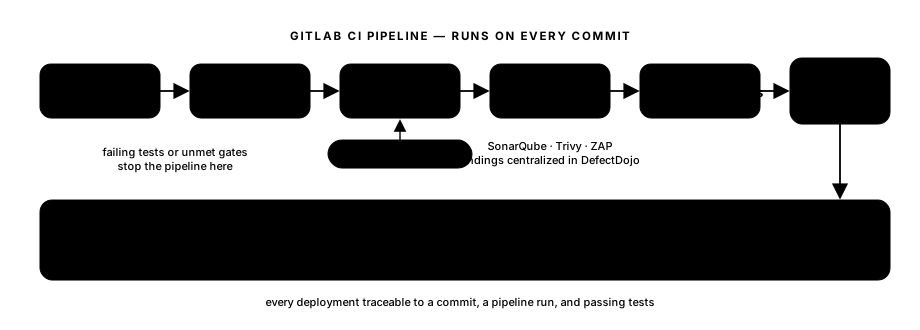
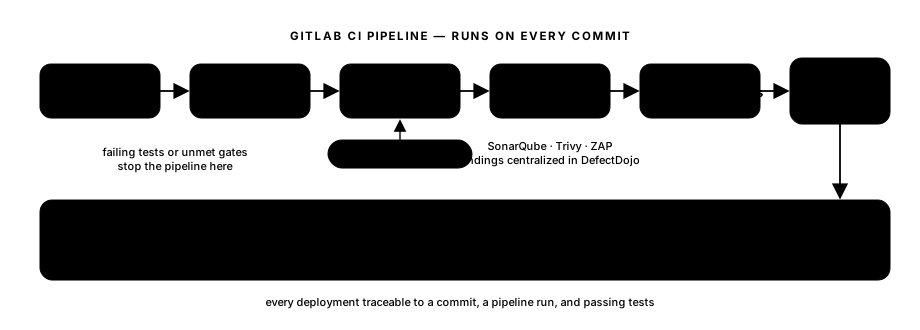
Powered by GitLab CI, SonarQube, and ArgoCD
Opstella provisions GitLab CI/CD pipelines from enterprise templates, wires quality analysis into SonarQube, security scanning into Trivy, ZAP, and DefectDojo, and delivers through ArgoCD with GitOps — all pre-integrated and managed from the Opstella portal.
Key Capabilities
Pipeline Templates, Ready on Day One
Every new component gets a complete pipeline from a curated template — build, test, scan, package, and deploy stages pre-wired for your language and framework. Teams start from a proven baseline instead of writing CI configuration from scratch, and platform-wide improvements roll out by updating the template.
Automated Unit and Integration Testing
Unit tests and integration tests run automatically inside the pipeline on every commit and merge request. A failing test stops the pipeline before anything reaches an environment, and because tests execute on every change, they stay continuously in sync with the codebase as it evolves — there is no separate, manually triggered test cycle to fall behind.
Test Coverage Quality Gates
Pipelines publish test results and coverage to SonarQube, where quality gates enforce a minimum test-coverage threshold — for example, requiring at least 80% line coverage — alongside rules for bugs, vulnerabilities, and code smells. Code that does not meet the gate fails the pipeline and cannot be promoted, making coverage a hard requirement rather than a report nobody reads.
Scenario and End-to-End Test Stages
Beyond unit and integration tests, pipelines support dedicated stages for scenario, end-to-end, and performance testing against deployed environments such as SIT and UAT. Test stages are first-class pipeline citizens: versioned with the code, executed automatically, and gating promotion to the next environment.
Security Scanning in Every Build
Each pipeline run performs static code analysis (SonarQube), container image scanning (Trivy), and dynamic application scanning (ZAP), with findings collected into the centralized DefectDojo security dashboard. Vulnerabilities surface at build time — when they are cheapest to fix — not in a quarterly audit.
GitOps Delivery Across Environments
Deployments are driven by ArgoCD using GitOps: the desired state of every environment lives in Git, and promotion through DEV, SIT, UAT, PRE, and PRD is a controlled, auditable change. Every deployment is traceable to a commit, a pipeline run, and a set of passing tests — and rolling back means reverting a revision, not reconstructing state by hand.
Standards & Compliance
| Requirement area | How Opstella CI/CD addresses it |
|---|---|
| Automated testing | Unit and integration tests execute automatically in CI on every change; failures block delivery. |
| Coverage enforcement | SonarQube quality gates enforce configurable coverage thresholds (e.g. ≥ 80% line coverage). |
| Scenario testing | Dedicated pipeline stages for scenario / end-to-end tests against integrated environments. |
| Test maintenance | Tests run on every commit, keeping suites aligned with system changes continuously. |
| Security | SAST, container, and DAST scanning on every build, centralized in DefectDojo. |
| Traceability | GitOps delivery — every deployment auditable to commit, pipeline, and test evidence. |
| Environments | Consistent promotion across DEV, SIT, UAT, PRE, and PRD. |
INFO
Coverage thresholds, quality-gate rules, and pipeline stages are configured per organization policy during onboarding.